
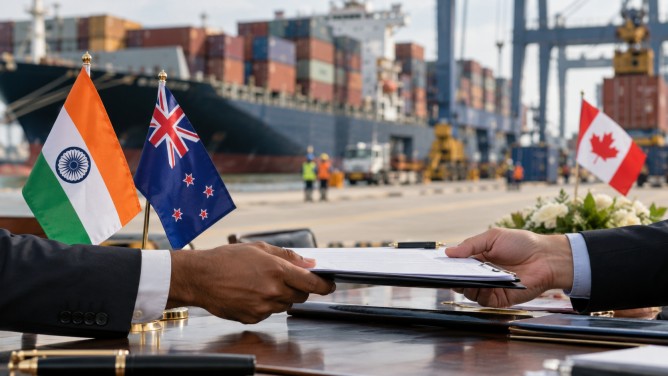
India’s free trade agreement (FTA) with New Zealand is set to commence on October 20, 2026, marking a significant step in India’s strategy to enhance its export potential and reinforce international trade relationships. This agreement, signed in April 2026, will offer Indian exports duty-free access to New Zealand, benefiting sectors such as textiles, leather, footwear, engineering goods, and processed agricultural products.
In parallel, India is accelerating its efforts to finalize a trade agreement with Canada by the end of the year. The India-Canada Comprehensive Economic Partnership Agreement (CEPA) aims to cover a wide range of areas including trade in goods and services, investment, rules of origin, intellectual property rights, and trade remedies. The fifth round of negotiations took place in Ottawa from October 5 to 9, with the next round slated for early November in New Delhi.
India’s proactive trade strategy extends beyond New Zealand and Canada. The country is also engaged in negotiations with the United States, Israel, Chile, and Peru. Additionally, India is revisiting or upgrading existing trade agreements with partners such as Australia, ASEAN, South Korea, and Sri Lanka. These efforts are part of a broader initiative to diversify India’s export markets and improve business access amid evolving global trade policies.
The implementation of the India-New Zealand FTA represents a crucial development in India’s international trade pursuits, offering significant opportunities for Indian businesses in key sectors. As negotiations with Canada continue, both countries aim to reach a comprehensive agreement that would further elevate their bilateral trade relations.